Who Gets to Call It Real? The Messy Online Fight Over Syrian-Lebanese Authenticity
The Comment That Started a Fight
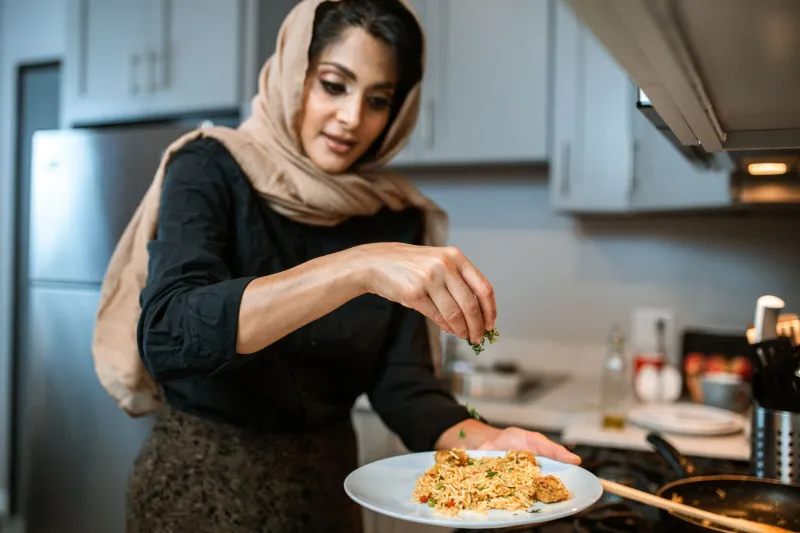
It was a reel about fattoush. Bright, cheerful, sixty seconds long—a second-generation Lebanese-Syrian woman in her kitchen, chopping cucumbers, squeezing lemons, tossing in toasted pita. The caption said Teta's recipe. Within hours, the comments were a warzone.
That's not how we make it in Tripoli. You forgot the pomegranate molasses. My Syrian grandmother would never use that dressing. This is a Lebanese dish, not Syrian. And then, inevitably: Okay but it looks delicious though.
Welcome to the authenticity wars—where Syrian-Lebanese heritage meets the attention economy, and where the question of who gets to represent this culture has never been louder or more contested.
Democratization Has a Price
For decades, Syrian-Lebanese culture in America was transmitted through family kitchens, church basements, and community events that required physical proximity to access. If you didn't have a grandmother nearby or a local cultural organization to plug into, your connection to heritage could feel thin and hard to maintain.
Social media changed that. Suddenly, a third-generation Syrian-American kid in rural Ohio could find a whole community of people making arak cocktails and arguing about the right ratio of bulgur to meat in kibbeh nayeh. The diaspora became visible to itself in a new way—and that's genuinely meaningful.
But visibility also invites scrutiny. And in a culture that has historically placed enormous weight on doing things the right way—the way the village did it, the way your grandmother did it, the way it's been done for generations—the internet has become both a celebration hall and a courtroom.
"Social media gave everyone a microphone," says a food blogger who runs a Syrian-Lebanese recipe account from her home in Houston. "Which is great. But it also gave everyone a gavel. And sometimes the people most aggressive about policing authenticity are the ones furthest removed from the actual source."
The Geography of 'Correct'
One of the thorniest problems in these debates is that Syrian and Lebanese cuisine—like the cultures themselves—have never been monolithic. A dish that's prepared one way in Aleppo might look completely different in Homs or Sidon. Coastal and mountain communities developed distinct culinary traditions. Urban and rural families passed down different techniques. The very idea of a single correct version of most dishes is a fiction.
And yet, online discourse has a flattening effect. Nuance doesn't go viral. What does go viral is the confident claim—this is the authentic recipe, full stop—even when that confidence is built on one family's particular tradition and presented as universal truth.
This gets especially complicated when Syrian and Lebanese identities get conflated or pitted against each other. The two cultures share enormous overlap in food, language, and history, but they're not the same—and diaspora members from both backgrounds can bristle when that distinction gets glossed over, especially when they feel their specific tradition is being erased or absorbed.
"I've seen Lebanese American creators post something and Syrian Americans pile on saying it's actually Syrian," says one content creator who identifies as both. "And then the reverse. It's like people are using food to settle identity scores that have nothing to do with cooking."
Generation Gap in the Comments Section
The authenticity debate also cuts across generations in ways that are genuinely revealing. Older diaspora members—those who came directly from Syria or Lebanon, or whose parents did—sometimes watch younger, American-born creators with a mix of pride and mild exasperation. They appreciate the enthusiasm. They wince at the shortcuts.
For the younger generation, the relationship to heritage is necessarily more constructed. They didn't grow up in the village. They learned the recipe from a parent who learned it from a grandparent who maybe didn't measure anything. Their version is a transmission of a transmission—and it's still real, even if it's not identical to the original.
What's interesting is that this tension isn't new. Every immigrant generation has navigated the gap between the culture they inherited and the culture they're practicing. Social media has just made that negotiation public and permanent.
"My mom corrects me in the comments sometimes," laughs one young woman who posts Syrian-Lebanese cooking content from her apartment in Brooklyn. "Which is embarrassing but also kind of sweet? She's proud that I'm doing it. She just wants me to do it right. And her version of right is different from my aunt's version of right, which is different from what I find online."
What Heritage Gatekeeping Is Really About
When someone insists that your version of a dish isn't authentic, they're rarely just talking about food. They're talking about belonging. About who has the right to claim an identity. About the fear—real and understandable—that cultural dilution is happening in real time and that no one is guarding the gate.
For communities that have experienced displacement, war, and diaspora, the anxiety around cultural preservation is not abstract. It's rooted in genuine loss. When you've watched a language fade within a single generation, when you've seen a neighborhood in Beirut reduced to rubble, when you've buried the last person in your family who knew how to make a particular dish the old way—the stakes of getting it right feel enormous.
But gatekeeping also has costs. It can shame people out of engaging with their heritage at all. It can make the tent feel smaller than it needs to be. And it can mistake rigidity for preservation, when the cultures it claims to protect have always been dynamic, adaptive, and alive precisely because they've absorbed change.
Making Room for Imperfect Love
The best corners of Syrian-Lebanese social media—and they do exist—are the ones where someone can post a slightly off-ratio tabbouleh and get five comments offering gentle suggestions instead of a pile-on. Where dialect differences are celebrated rather than corrected. Where a third-generation kid in Michigan making his grandmother's recipe from memory gets applause for trying, not a lecture on what he missed.
Authenticity matters. Heritage matters. But so does the act of reaching toward something that's yours, even imperfectly, even from a distance. The Syrian-Lebanese diaspora is not a museum. It's a living community. And living communities argue, adapt, and evolve—even in the comments section.