No Pews Required: Syrian-Lebanese Americans Are Finding Community on Their Own Terms
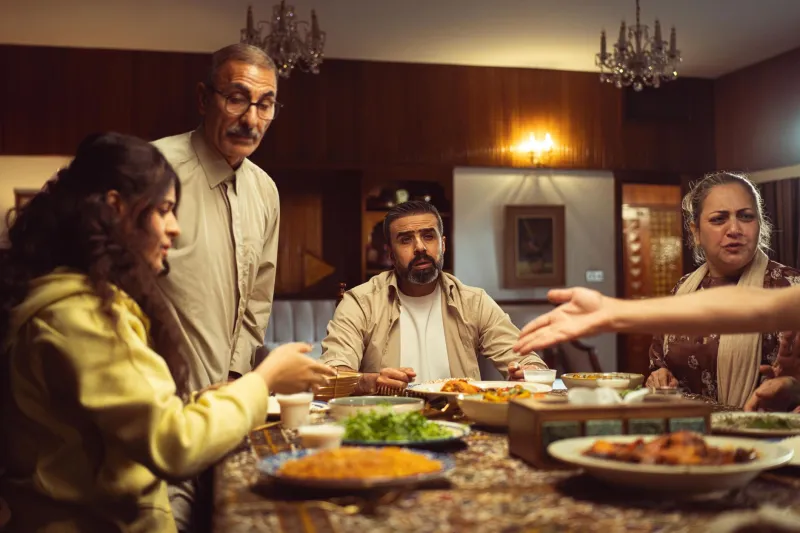
On the third Sunday of every month, about twenty people crowd into a living room in Astoria, Queens, to eat food, argue about music, and speak Arabic badly at each other. There's no formal agenda. No dues. No application process. You find out about it through a friend, show up once, and either you're in or you're not.
The host, a 28-year-old Syrian American named Samer who works in UX design, calls it a sofreh — a spread, a gathering, a table. He started it during the pandemic because he missed the density of Syrian social life and didn't know where else to find it.
"I'm not religious," he says plainly. "I grew up going to the mosque with my family, but it was never really my space. When I got to New York, I realized there was no place for someone like me to be Syrian in a room full of Syrians. So I made one."
Samer's sofreh is one small example of something happening at scale across the US. Syrian-Lebanese Americans — particularly younger adults — are increasingly constructing community outside the traditional institutions that anchored previous generations. And the results are as varied and creative as the people building them.
What the Old Model Offered (And What It Didn't)
For the first and second generations, mosques and churches weren't just spiritual spaces — they were the infrastructure of community life. They hosted weddings and funerals, ran Arabic school on Saturdays, organized fundraisers, and served as the first phone call when a family needed help. In cities like Dearborn, Detroit, and Brooklyn, these institutions built entire social ecosystems.
That model still works for a lot of people. But for others — particularly those who are religiously unaffiliated, queer, politically nonconformist, or simply geographically scattered — the traditional institution doesn't fit.
"The church was my parents' community," says Lara Khodr, 32, a Lebanese American living in Portland, Oregon. "And I respect that. But I'm not Christian in the way they are, and I'm gay, and I just — I wasn't going to find my people there."
She found them in a Syrian-Lebanese cookbook club she joined through Instagram, which led to a broader group that now meets monthly for potlucks and occasionally organizes around issues affecting Lebanon. "It started as food and became something much bigger," she says.
The New Infrastructure
What's emerging in place of — or alongside — traditional institutions is a patchwork of informal structures that prioritize flexibility and self-definition.
Dinner clubs and supper gatherings are probably the most common. They tend to be food-centered, which is no accident — the Syrian-Lebanese table has always been a site of belonging, and it translates easily into secular settings. You don't have to agree on theology to agree on kibbeh.
Music circles are another hub. Across cities with significant diaspora populations, small groups are gathering to play and listen to Levantine classical music, dabke, and contemporary Arab pop — outside of formal cultural centers, in bars, apartments, and rented community spaces. These aren't performances so much as participatory rituals.
Online communities have become surprisingly important, especially for Syrian-Lebanese Americans in smaller cities where the in-person community is thin. Private Facebook groups, Discord servers, and WhatsApp threads serve as constant low-grade connection — a place to ask where to find good halloumi in Kansas City, to share news from back home, or to process grief collectively.
And then there are activist and advocacy networks, which have drawn younger Syrian-Lebanese Americans in large numbers — particularly in the wake of the Beirut port explosion in 2020 and ongoing conversations about Syrian displacement and reconstruction. For many, political engagement has become a form of cultural identity in itself.
Spirituality Without the Building
One of the more nuanced aspects of this shift is what happens to spiritual practice when it decouples from institution.
Many younger Syrian-Lebanese Americans describe themselves as spiritual but not religious — or as culturally Muslim or culturally Christian without active practice. And they're finding ways to honor that complexity.
"Ramadan is still important to me," says Rania Saleh, 27, a Lebanese American in Los Angeles. "But I don't observe it the way my parents do. I fast some days. I cook the foods. I call my grandmother. It's mine, even if it looks different."
This kind of personal, customized relationship to tradition isn't unique to Syrian-Lebanese Americans, of course. It's a broader generational pattern across many faith communities in the US. But within this diaspora, it carries a particular weight — because for many families, religious identity and ethnic identity were deeply fused. Separating them feels like a risk.
"My mom worries that if I'm not going to church, I'm losing something," says Lara. "And maybe I am. But I'm also building something. I just wish she could see that."
What This Means for the Future
The institutions aren't going away. Mosques and churches in Syrian-Lebanese communities remain vital for many families, and they're adapting too — offering more programming for younger members, engaging with social justice issues, and in some cases actively welcoming LGBTQ+ community members. The picture is more complicated than a simple decline narrative.
But the center of gravity is shifting. Belonging, for this generation, is something you construct rather than inherit. And the Syrian-Lebanese community in America — always resourceful, always adaptive — seems to be figuring out how to do that in ways that still feel genuinely theirs.
Samer's sofreh in Astoria is still going. Last month, someone brought their grandmother. She spoke only Arabic, ate everything, and cried a little before she left. Nobody asked why.
Some things don't need a building.