Gold, Envelopes, or a Registry? How Syrian-Lebanese Americans Are Rethinking the Wedding Gift
There's a moment that happens at almost every Syrian-Lebanese American wedding. A guest — maybe a cousin who grew up stateside, maybe a college friend who's never been to a Middle Eastern celebration before — walks up to the gift table holding a small wrapped box from a department store registry. Meanwhile, the aunties in the corner are quietly comparing notes on who gave what in the envelope pile, and someone's grandmother just handed the bride a gold bracelet that's been in the family since Beirut.
These scenes coexist. They've always coexisted. But lately, more families are actually talking about the tension — and figuring out what to do about it.
What the Tradition Actually Looks Like
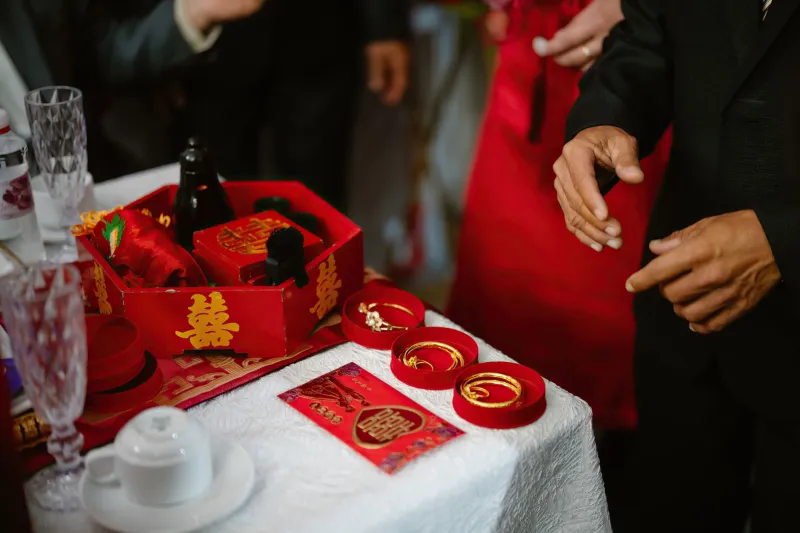
In Syrian and Lebanese culture, wedding gift-giving has historically been pretty direct. Cash in envelopes is standard — and not in a casual way. There's an unspoken social calculus involved. The amount you give reflects your relationship to the family, your economic standing, and sometimes, your community reputation. Giving too little is noticed. Giving generously is remembered for years.
Gold is the other big one. Jewelry — particularly pieces given to the bride — carries deep symbolic weight. It's not just decoration. It's a form of financial security, a wearable investment, and a marker of family status. A mother-in-law presenting a gold set at a Lebanese wedding isn't just being generous; she's making a statement about how her family values the union.
There are also ceremonial items that vary by family and region — specific sweets, particular fabrics, or ritual objects tied to regional traditions that some families still carry across generations and oceans.
The Registry Problem
American wedding culture, as anyone who's planned or attended a wedding here knows, runs almost entirely on registries. You pick out what you want, guests buy it, everyone's happy. It's efficient. It's practical. And for many second- and third-generation Syrian-Lebanese Americans, it's also what they grew up expecting.
"When my husband and I got engaged, we set up a registry because that's just what you do," says Nadia, a 31-year-old Lebanese American from Dearborn, Michigan. "But then my mom sat me down and said, 'Our people don't do that.' I didn't even realize I'd kind of skipped over the whole conversation."
Nadia ended up keeping the registry but made sure their wedding coordinator communicated clearly with guests from both sides of the cultural divide. "We told the American side about the registry, and the Arab side already knew what to do. It worked out, but it required a lot of behind-the-scenes coordination."
That behind-the-scenes coordination is something wedding planners who work with Syrian-Lebanese communities have learned to build into their process.
What Wedding Planners Are Seeing
Rania Haddad, a wedding coordinator based in the Detroit metro area who has planned dozens of Syrian and Lebanese American weddings, says the gift question comes up in almost every consultation.
"There's a real generational split," she explains. "The parents want the gold, the envelopes, the tradition. The couple might want a honeymoon fund or a registry. And then you've got the American friends who have no idea what to do when they show up and there's no gift table."
Haddad now recommends what she calls a "both-and" approach. Couples set up a registry for guests who prefer that route but also make clear — through word of mouth, through family communication, sometimes even through wedding website language — that cash and gold are not just acceptable but welcome.
"The key is removing the ambiguity," she says. "When guests don't know what's expected, they get anxious. When you tell them directly, everyone relaxes."
The Unspoken Rules Nobody Talks About
Here's the part that doesn't make it onto wedding websites: within Syrian-Lebanese communities, the gift-giving tradition carries a kind of social memory. Families remember what was given at whose wedding, and there's often an expectation of reciprocity over time. If your family gave generously at someone's daughter's wedding, you might quietly expect the same when your own child marries.
This isn't transactional in a cynical sense — it's relational. It's how communities have supported each other financially across generations, especially in diaspora contexts where extended family networks serve as informal safety nets.
"My parents gave at probably 200 weddings over the years," laughs Karim, a 35-year-old Syrian American from New Jersey. "When my sister got married, there was definitely an expectation that people would show up. And they did. It's like a community savings account."
For younger generations who didn't grow up fully inside that network, the logic can feel foreign. But many say that once they understood it, they appreciated the underlying intention.
Making It Work Across Both Worlds
So what do you actually do if you're a Syrian-Lebanese American planning a wedding, or attending one, and you're not sure what's expected?
A few things that community members and planners consistently recommend:
If you're the couple: Be explicit, not subtle. If you want both a registry and cash/gold to be acceptable, say so clearly. Your wedding website is a good place to address this — something as simple as "We have a registry for those who prefer it, and we also welcome traditional gifts" takes the guesswork away. Talk to your parents early. Their community connections will drive a lot of the gift-giving behavior from the Arab side, and they need to be on the same page.
If you're an American guest at a Syrian-Lebanese wedding: When in doubt, a card with a check or cash is almost never wrong. Don't overthink it. If you're close to the family, you can ask directly — most people appreciate the consideration.
If you're a Syrian-Lebanese guest at a more Americanized wedding: Check whether there's a registry, but don't feel obligated to use it exclusively. Cash in an envelope, or a piece of jewelry if you're close to the family, remains a deeply meaningful gesture in most Syrian-Lebanese households.
The Bigger Picture
The wedding gift question is really just one small window into a much larger conversation Syrian-Lebanese Americans are having about how to hold two cultural identities at once. It's not about choosing one tradition over another — it's about finding ways to let both breathe in the same room.
For Nadia, the Dearborn bride, the day ended up feeling exactly right. "My college friends bought stuff off the registry. My teta gave me a gold necklace she'd been saving for years. Both felt like love. They just looked different."
That's probably the most honest answer to the whole dilemma: tradition and adaptation aren't opposites. In Syrian-Lebanese American life, they've always been conversation partners — and the wedding table might be the most honest place that conversation happens.