Between Two Hearts: How Syrian-Lebanese Americans Are Rewriting the Rules of Love Without Losing Their Roots
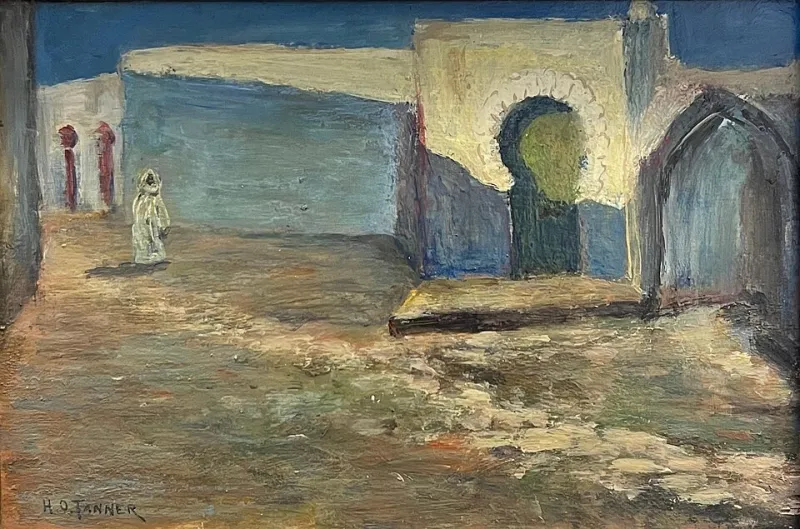
Photo: Henry Ossawa Tanner, Public domain, via Wikimedia Commons
Nadia was 27 when her mother started leaving subtle hints around the apartment. A torn-out magazine article about a Syrian-American dentist in New Jersey. A casual mention of a "nice boy from a good family" at the church picnic. A slightly less casual mention the following week, and the week after that.
"She wasn't wrong that I wanted to meet someone," says Nadia, a Lebanese-American graphic designer based in Dearborn, Michigan. "She just had a very specific idea of who that someone should be. And I had a very different idea of how I was going to find him."
Nadia's experience isn't unusual. Across Syrian and Lebanese American communities — from the tight-knit enclaves of Detroit and New Jersey to smaller diaspora pockets in Houston and Los Angeles — the question of who you marry, how you meet them, and what role your family plays in the whole process is one of the most loaded conversations a young person can have. And increasingly, those conversations are changing.
The Old Playbook
For first-generation Syrian and Lebanese immigrants, the courtship script was fairly well understood. Family networks did the heavy lifting. Word got around. Parents consulted other parents. Community leaders, priests, imams, and the occasional well-connected aunt served as informal matchmakers. The couple might meet a handful of times before an engagement was announced. Romance, if it happened, was largely a bonus.
That system wasn't without its warmth. Many people raised in it will tell you it worked — that there's something genuinely reassuring about being loved into a relationship by people who know your family, your values, your background. "My parents met through their families and they've been together for 40 years," says Ramzi, a 34-year-old Syrian-American software engineer in Chicago. "I'm not going to tell you that model is broken."
But he also won't pretend it translates cleanly to his own life. He's been on Hinge. He's had relationships his parents didn't know about. He's also sat through family dinners where a potential match was brought up so casually it felt like a business transaction. "There's a tension," he says, "between respecting where you come from and figuring out who you actually are."
What the Second Generation Actually Wants
Talk to enough Syrian-Lebanese Americans in their 20s and 30s and a few common threads emerge. Most of them want a real emotional connection before anything gets serious. They want to date — even if that word makes their parents wince. They want to feel like the choice is theirs. And at the same time, a surprising number of them also want their family's blessing, maybe even their involvement. They're not rejecting tradition so much as trying to renegotiate it.
"I don't want an arranged marriage," says Lara, a 29-year-old Lebanese-American teacher in Brooklyn. "But I also don't want to bring someone home after two years and have my family meet him for the first time at Thanksgiving. That's not my culture. That's not who I am."
What she describes — and what many young Levantine Americans seem to be quietly building — is something in between. A hybrid model where you meet someone on your own terms, get to know them at your own pace, and then bring the family in earlier than a typical American might but later than a traditional Lebanese family would expect. It's a negotiation that happens in real time, relationship by relationship.
The Parent Problem (And the Parent Perspective)
It would be easy to cast parents as the obstacle in this story. But spend some time talking to them and the picture gets more complicated.
May, a Syrian-American mother of three in suburban Virginia, raised her kids with what she calls "open hands" — she encouraged them to make their own choices while being transparent about her hopes. "I didn't want to push them away," she says. "I've seen what happens when parents push too hard. The kids run. They hide things. That's worse."
Still, she admits she had preferences. She wanted her children to marry someone who understood the food, the language, the way a Syrian household works. Not because she was closed-minded, she insists, but because she knew how hard it would be to explain everything from scratch. "Culture is not just food and music. It's how you fight. How you forgive. How you treat a mother-in-law. It's deep."
That perspective — that shared cultural fluency makes a marriage easier — isn't just sentiment. Researchers who study immigrant family dynamics have noted that couples who share ethnic or religious backgrounds often report fewer friction points around major life decisions, including how to raise children, how to handle extended family, and what home actually feels like. It's not a reason to limit yourself, but it's not nothing, either.
When It Gets Complicated
Of course, not every story ends in comfortable compromise. Some Syrian-Lebanese Americans have had to make genuinely hard choices — pursuing relationships their families didn't approve of, marrying outside the community, or coming out in contexts where that added an entirely different layer of complexity to an already charged conversation.
"I'm gay and Lebanese-American," says Omar, 31, who asked to use only his first name. "The matchmaker conversation was never going to apply to me the way it applied to my cousins. But the pressure to perform a certain kind of life, to make my family proud in the ways they understood — that was absolutely real. I felt all of it."
For him, navigating love in the Lebanese-American community has meant building a chosen family alongside his biological one, finding community in LGBTQ spaces that also honor Arab identity, and slowly, painstakingly, having honest conversations with relatives who are still catching up. "It's a long game," he says. "But I'm still in it."
A New Kind of Matchmaking
Interestingly, formal matchmaking hasn't disappeared — it's just evolved. There are now Syrian and Lebanese American matchmakers operating across the country who work specifically with diaspora communities. Some use apps tailored to Arab Americans. Others run curated events that feel more like cultural mixers than awkward setups. The goal is to create space for connection that feels both modern and rooted.
"People want to meet someone who gets it," says one matchmaker who works primarily with Lebanese-American clients in the New York metro area. "They want the shorthand. They don't want to spend three dates explaining why they call their grandmother every Sunday."
Love, With Context
What's emerging across these conversations isn't a clean break from tradition or a wholesale adoption of mainstream American dating culture. It's something messier and more honest than either. Syrian-Lebanese Americans are figuring out love in a way that holds multiple truths at once — that family matters and so does personal autonomy, that culture is worth preserving and also worth questioning, that a good marriage probably needs both chemistry and compatibility, and that sometimes those things come in forms nobody expected.
Nadia, for what it's worth, did eventually meet someone. Not through her mother's magazine clippings, but not entirely without her mother's influence either. "She'd always told me to look for someone kind first," Nadia says. "Turns out, that was actually good advice."
Some things, it seems, translate just fine.