Feed Everyone First: What the Syrian-Lebanese Table Really Means in America
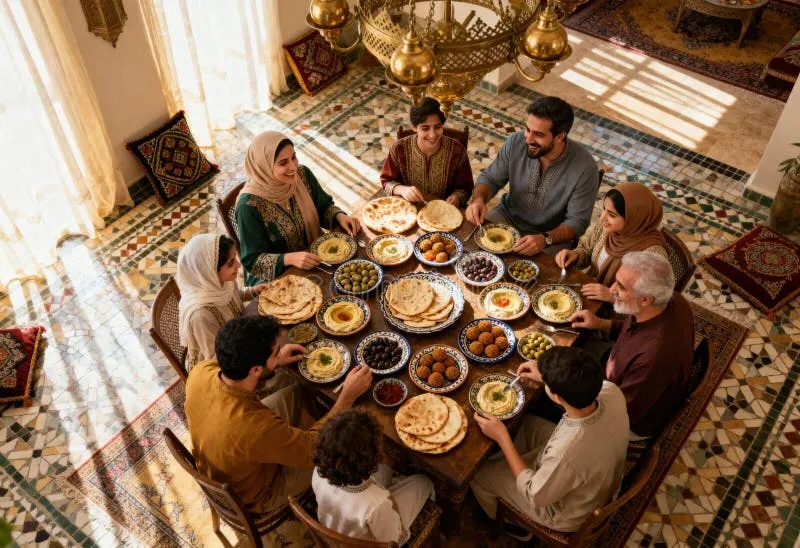
Photo: Middle Eastern family gathered around large traditional meal spread at home, via thumbs.dreamstime.com
Walk into a Syrian or Lebanese home in America and there's a good chance someone will try to feed you within five minutes of arriving. It doesn't matter if you said you already ate. It doesn't matter if you're just dropping something off. A plate will appear. Bread will be torn. Coffee will be made.
This isn't just hospitality. It's a whole philosophy of being in the world.
Diyafa: More Than a Word
The Arabic concept of diyafa — generous, unconditional hospitality — doesn't translate cleanly into English because English doesn't really have a word for it. "Hospitality" is close, but it implies something optional, something you choose to extend. Diyafa is more like an obligation in the best possible sense. It's a moral stance. You feed people because that's what it means to be human, and because your home is not really yours alone — it belongs to whoever walks through the door.
For Syrian and Lebanese families who immigrated to the United States, diyafa has taken on additional layers of meaning. In a country where they've sometimes felt invisible, unwelcome, or misunderstood, the table becomes a place where they hold the authority. Where their culture is the standard. Where the rules are theirs.
"When I have people in my home, I'm not a minority," said Hala Mansour, a Syrian-American mother of three who's lived in suburban Atlanta for almost twenty years. "I'm the host. That's a different feeling."
The Meal as Memory
For many families, specific dishes function less like recipes and more like archives. The particular way a grandmother folded kibbeh, the exact ratio of seven-spice in a pot of mujaddara, the insistence on serving certain things in a specific order — these details carry enormous emotional weight. They are the tactile, edible form of a history that can't always be told in words.
Rima Aziz, who grew up in a Lebanese-American household in Dearborn, Michigan, remembers her mother refusing to write down any of her recipes. It wasn't stubbornness — it was philosophy.
"She said if you write it down, you stop paying attention," Rima told us. "You have to watch. You have to be there. That's the point."
That insistence on presence, on learning through proximity rather than instruction, is itself a cultural value. The kitchen in a Syrian-Lebanese home is not a place you visit to retrieve food. It's a place where knowledge is transmitted, where stories get told between stirs, where children absorb who they are without being explicitly taught.
Rima now teaches her own kids the same way. Her fourteen-year-old daughter can make a proper hummus from scratch and knows, without being told, that you always taste before you serve.
Setting the Table Across Generations
Not every family has been able to maintain these traditions intact. Migration disrupts things. Ingredients that were common in Aleppo or Beirut are harder to source in certain parts of the US. Children raised in America develop different palates, different schedules, different relationships to the communal meal. The long, unhurried Friday lunches that define Syrian-Lebanese family life can feel impossible in a country that runs on thirty-minute lunch breaks and back-to-back weekend activities.
But families find ways to adapt without fully letting go.
The Haddad family in Houston has turned Sunday dinner into something close to a weekly ritual. Three generations gather every week — grandparents, adult children, grandkids — around a table that takes two hours to set and four hours to eat. The youngest grandchildren, who speak more English than Arabic, still know the names of every dish. They know you don't start eating until the eldest sits down. They know you offer before you take.
"It's not about the food," said George Haddad, the family patriarch, who came to the US from Lebanon in 1987. "The food is just how we get everyone in the same room."
A Political Act at the Dinner Table
In the years following 2016, as Syrian refugees became a flashpoint in American political debates, many Syrian-American families found themselves navigating a strange dual reality: their culture was being discussed on cable news while they were trying to figure out whether their neighbors saw them as a threat.
Food became, for some families, a form of soft diplomacy. Church potlucks, neighborhood gatherings, school fundraisers — these became opportunities to put something on a table and let it do the talking. A tray of baklava travels differently than a political argument.
"I brought food to every school event for years," said Fatima Nassar, a Syrian-American woman in Minneapolis. "I knew people were nervous around us after everything in the news. So I just kept feeding them. Eventually they stopped being nervous."
This is diyafa as resistance. Not loud or confrontational, but persistent. The act of feeding someone requires them to receive something from you, and in that exchange, something shifts.
What Gets Passed Down
The deeper question, for many Syrian-Lebanese families, is what their American-born children will carry forward. Not just the recipes, but the values embedded in the rituals. The understanding that a meal is an act of love. That abundance is meant to be shared. That a guest should never leave hungry, and probably shouldn't leave at all until they've had at least three rounds of tea.
These things are harder to teach explicitly than they are to absorb through years of Sunday dinners and holiday feasts and ordinary Tuesday nights when someone happened to stop by and a full meal appeared out of nowhere.
Rima Aziz's daughter, the one who can already make hummus from scratch, was asked recently what she thought her cultural identity was. She thought about it for a second.
"Lebanese," she said. "But also American. But when I cook, I feel more Lebanese."
That's probably the most honest answer anyone could give. The table holds things that words can't always reach. And as long as someone keeps setting it, the culture has somewhere to live.